Showing posts with label Test. Show all posts

Monday, April 8, 2013

Raw Power: The 'Final' Food Test

You all have clearly seen that my posts are pretty much about two things: food and bikes. The latter is ever-changing because, well, that is the nature of cycling.

The former (at least for me) is an amoebic, morphing organism that evolves to seemingly better and better levels. This is well explained, as I don't really jump into things without considering the implications and benefits or possible detractions of such a change. Thus, my slow move into vegetarian was pretty smooth (minus that little self-diagnosed anemia, thanks to not having good options on a college meal plan). After that, I was more cautious about changing my diet. Basically I took a more educated approach than a trial & error method! Trial and error is great when the risk is between small and zero, but not when it deals with your health.

My trip to Books-A-Million...the foodie book store in the old port apparently closed. But it is now an OYSTER BAHH. Oyster fans, check it out.

Which leads me to a really good spot: anything you do to change your diet, training, etc make sure you know what you are doing, why you are doing it, and how you plan to go about it. (This could mean using previous knowledge, a coach, nutritionist, or books. I would say consult your doctor...but there is some chance you could hear that something like a vegan diet is "extreme" and you need milk/red meat/'protein'. My doctor responded well when I said I was vegan - however, I have heard some pretty surprising stories...but if you should ask your doctor for a nutritionist reference, then I am sure you're on very good track)

This probably won't be the 'final' food test as the post title suggests, but in my recent diet of vegan and then adding gluten free...going raw is the concept that I have (for quite a while) believed to be the 'ultimate'. The detractors of (increased) inconvenience, not being able to cook, and more adaptation kept it at bay until now.

What pushed it over the edge, you ask? Nothing in particular. I suppose basic desire for improving myself, something that is pretty constant in this great sport of cycling: every day I am better because I do more (sometimes less!) and forge on to greater progress.

At some point I'll go into greater detail on the intricacies of eating raw. The basic idea is that everything is in its simplest form, ready to be disgested and completely unprocessed. There is no breakdown of enzymes. The food is pure.

My plan going forward (key: having a PLAN!! is key to changing things up): I'm not sure if I will go 100% raw because I truly enjoy cooking and baking, and there are some things that become quite difficult when being 100% raw. So the long term is a "we shall see". The short term will basically go as this:
  • Buy more foods in raw form - and reduce non-raw purchases (see picture A)
  • Cook/bake for specific purposes that I really enjoy versus cooking because it's what I am used to
  • Work on un-cooking/un-baking (making things that are both raw and require preparation: see picture B)
  • Make my current 'favorites' in raw form (granola bars, muffins, brownies, etc)
My trip to BJ's. When you eat as much as me, you buy in bulk.
Some things probably won't go, honestly my OTB (on the bike) food works so well I am hesitant to alter that. Bars + PROBARs have fueled me to many sucessful races and workouts over the past year that I don't intend to leave them behind. I will try to make my bars in a raw form - without boiling the  nut butter/sweetener mixture and also not baking them....time for a dehydrator or long-term uncovered fridge storage (poor man's dehydrator!).

Here's the TK take on RAW POWAHH. My theory in shortest form: Raw Power = More Watts = Win.

Wednesday, March 14, 2012

VO2 Test to the "Max"

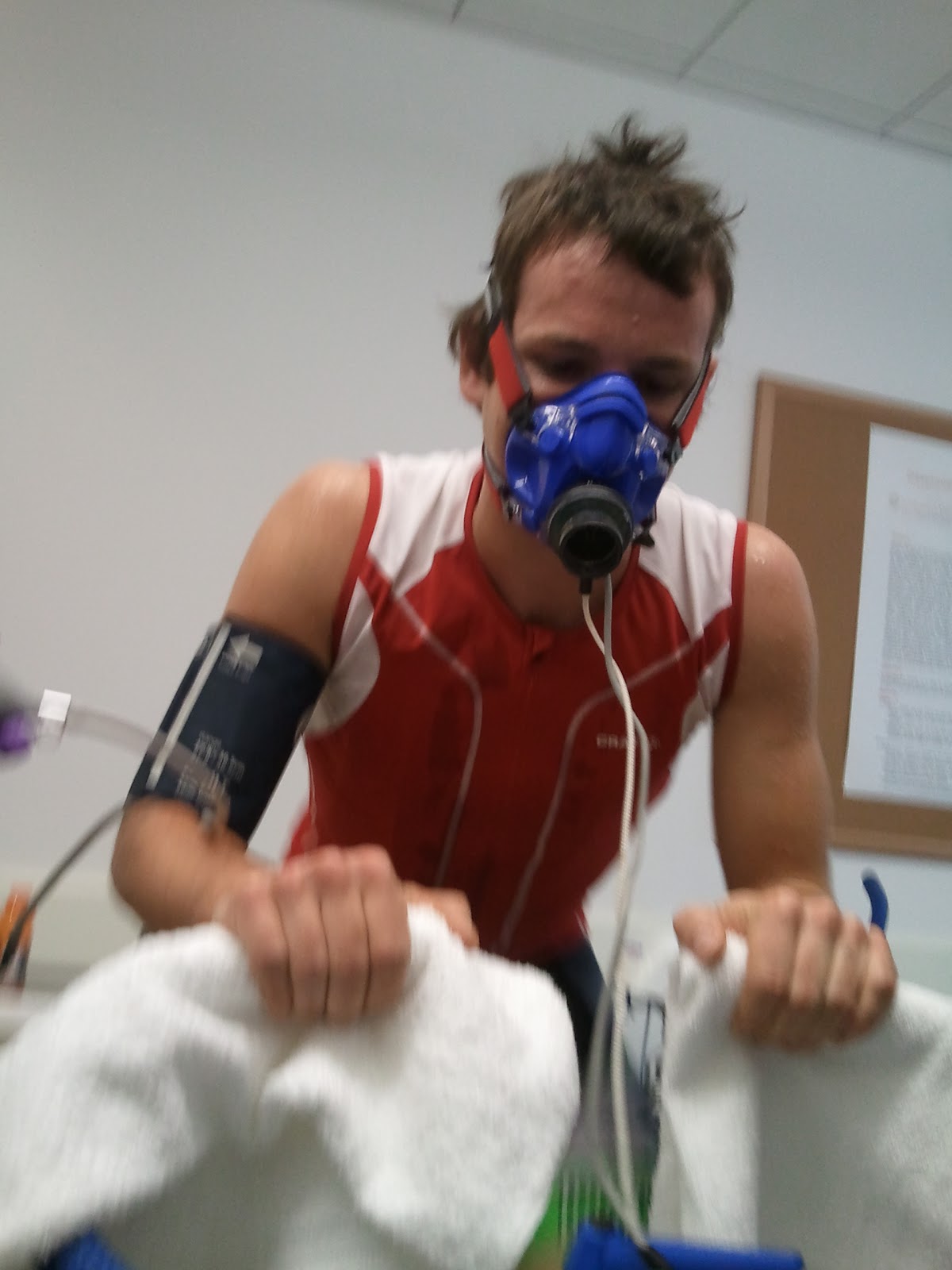
As a quick intro (as this post could get lengthy), a friend showed me a study that is going on at Northeastern University. In essence, it is comparing the response of males (age 18-35) who are healthy and Type I Diabetic in the presence or lack of a carbohydrate as fuel for exercise. The total test took 26 minutes at which point I completely blew up - my VO2 began to drop even though I continued to pedal. Once VO2 drops noticeably, the test is over because, well, you're not going to get a higher VO2 Max! It was done @ 60RPM steady (for ease of calculating power as a resultant, and for the specified repeatable protocol) with 5x2min at increasing resistance, then 3min intervals continually increasing until you bonk or VO2 values drop. This ergometer (AKA a work measuring exercise machine) used resistance units (in kp) as opposed to power (wattage), so VO2 Max power calculations are only estimates.

 Taking it easy. Not a comfortable bike fit by any means though!

"VO2 Max" is a term athletes of all types love to throw out there. You might hear someone say, "If only I could get my VO2 max to 70 or above, I'd be crushing the 5K in under 15 minutes!" Sure, VO2 Max determines the maximal uptake of oxygen of an individual during exercise and is thus a very good predictor of aerobic fitness. But what people really miss is that there are hundreds of other factors that actually play into being fast. The most important things in any sport are efficiency and economy, how much work you put in compared to what you get out. Example: A short paraphrase from Joe Friel's Blog on VO2 Max: Frank Shorter VO2 Max: 72, Bill Rodgers: 78. Who beat whom? Shorter won quite regularly. Basically having a high VO2 Max says that you have a good, solid engine. But if that engine is not well oiled, or the pistons aren't moving smoothly, or the explosions of the combustion are not well isolated then it won't go anywhere. The combination of having a big engine and an efficient engine is what makes and breaks world records. One or the other and you're an aerobic king whose running is a hobble, or you're a silky smooth athlete with perfect form and nothing to power it.

The test  itself was quite well run, as it should be for any scientific research. I had vitals taken while at rest prior to the test: Blood Pressure, Heart Rate, and Blood Glucose. John (name changed) briefed me on the procedure and what exactly I would be doing, all the overseers were very helpful - I brought my own pedals for the bike and they allowed me to adjust the seat to something moderately comfortable...I suppose I could have brought my backup saddle haha. They would monitor HR, BP, and all the VO2 values via the breathing mask. The mask was hot, dry, and a bit annoying considering that I usually intake a huge amount of water in training. So I warmed up a little bit cruising easy on the bike just to get the legs alive. I was not prepared for the 60RPM riding, also known as grinding it out, so I did a little of low rpm riding and was struggling to go below 70...this was going to be a blast!

The test started out easy on a 2/7 on their resistance scale, kp. Each level went up 0.5 kp. I indicated relative perceived exertion (RPE) at every stage and my BP was recorded by BP cuff in the middle of every stage, which ended up getting to be a pain one I hit a RPE of 15.

We started the ramp up and it was pretty darn easy, but it's supposed to be. I was aware how hard it would be getting in 15 minutes, but nevertheless was anxious for the 'real' part of the test. At this point my VO2 was in the 30's, as expected when the body is not being taxed - it doesn't need to utilize high oxygen uptake because the amount of oxygen being inhaled far exceeds the oxygen required by the cells, muscles, etc. Once that point is approached and turns is when the fun stuff happens. So we ramp up the resistance, and soon enough my RPE is 15 and we are into the 3 minute stages of the test. I'm still rolling along at a steady 60RPM, but am feeling the toll of the work I am putting in. The continual increase of effort with no rest is like running a race against Pre (if you haven't seen Without Limits...watch it) or climbing a hill at a constant speed but that darn hill's grade keeps increasing - and you're next to Jens Voigt, a man who doesn't know the phrase 'slow down'.

Stage 9, or 19 minutes into the test, things start hurting quite a bit. Any slight increase and my form will become rough and there is no smoothness in my pedal stroke. RPE is 18, heart rate (which was low for me on this day - not sure why) was into the 180's and climbing. John ramped up the resistance to 6.5 for stage 10, telling me that the ergometer could only go up to 7.0. If I continued through that stage, I would just increase RPM's until I bonked. I quickly learned that was not going to be necessary. John and his colleagues were pretty seriously cheering me on at this point, I later processed that it was humorous to think that these people in lab coats were pushing me to go harder. I wasn't sure if I would make it to 7.0 but I was destined to not let up until my body simply gave out. Midway through Stage 10 I saw the HR go into the 190's and my VO2 jump a little. I took this as motivation to hold out longer and push myself harder.

RPE = very high.

Stage 11: 7.0 kp. HOLY HELL. Well at least my BP is still stable...because nothing else was. The very moment they turned up the resistance I felt like molasses. After 5-10 seconds I made the adjustments and was up to 62rpm from getting pushed down to 57. If I didn't get above 60rpm the test would be over, as I would essentially have bonked and thus my body gave out and my Max VO2 value would not get any higher. Everything is completely burning at this point and I feel like I can't breathe - note: this feeling is normal when maxing oneself out, but when you have a mask on you just want to rip the damn thing off!


1 minute at 7.0kp and everything is empty, I am still pedaling above 60rpm but it must be a hideous sight: bouncy, strained, lacking any resemblance to smoothness. I overhear that my VO2 value is not increasing anymore...I look up and it has gone down since 30 seconds prior. I muster up enough strength to press on, but John says that the test is over because my VO2 is starting to decrease and, to my understanding, I have aerobically bonked and my legs are very quickly packing themselves full of lactate.

It hurt. But it was a great workout! Plus, I got all the data of my VO2 Max test, so it's pretty cool stuff. Luckily I have the knowledge to be aware that VO2 values are not the bottom line...so whether it was high or low from what I was expecting, it wasn't going to change a darn thing. Luckily it turned out well and put me right in a range I was thinking I would be.

All in all, I'm looking forward to heading back down to Northeastern for the last two tests - anaerobic wingate, yeehaw!

Friday, December 16, 2011

Pushing Through..and Finding that "Extra Gear"

As you all know, I broke my clavicle just over 4 weeks ago (to be exact: 4 weeks and 3 days), and I was doing my best to continue training through all of it. At points it did hurt a fair amount - and when it did I listened to my Doc's instructions of "Do not do anything that causes pain". So whatever actually hurt, I had to hold off on. Luckily, this was really only walking fast, running, and things that required range of motion (ie: reaching bike handlebars was way out of the question). Basically my biggest issue was sleeping and keeping comfortable throughout the day; putting on clothes and showering were more like a challenging game than a problem...and keeping a lot of tasks as independent as possible probably was my own form of early recovery PT. I quickly learned how far I could reach and what rate it was progressing at and also what I could carry in that arm and what I would be able to hold without pain in a week's time.

The one thing I did not let up on, was keeping myself active...even if it meant I could only withstand 25-30 minutes of high discomfort while on the trainer. Sometimes it isn't what you do, it's why you're doing it. I kept going because that's just a part of me and I've never let anything get in the way of what I enjoy on the most fundamental of levels. That is not to say nothing is more important (clearly, that is a different story), but usually a half hour is viable regardless of situation.

So I kept it up. And I progressed pretty damn quickly compared to what I expected - and what I had heard from a lot of other people. I was on the exercise bike the day after I crashed (and couldn't walk faster than 25:00min/mi without pain), I awkwardly jogged 0.5 miles for the first time 15 days after the crash, did my first bike workout on day 16, and ran just 23 days after the break. Today I did a brick and it was my third run of the week...my arm swing is even coming back!

What surprised even me (I usually have pretty lofty goals of recovering from injury and returning to good form) was a workout yesterday. A few of us at Maine Running had a Time Trial race on the CompuTrainers, it was a 19.7mi moderately hilly course with a noticeable net elevation gain overall. I knew I was going up against Ryan and Adam, but figured out once I got there that Doug Welling would be participating...so instantly I thought I was going to be absolutely destroyed in this race. It was all out of good fun, so I welcomed the challenge and I will be the last one to ever not want someone to push me to a new level. I had a pretty solid cold and little use of holding onto the handlebars, so it was going to be difficult no matter how I cut it (unless I dogged it, but that option is deemed erroneous before even being contemplated). I figured I should at least go out with hitting my date FTP, and then go from there. (For those of you who don't use power...FTP is functional threshold power: a wattage that was estimated from a workout a couple months back, and is the expected power output I can sustain for an all out 45-60 minute effort). I had never done a 1 hour TT and was both excited for it as a whole and a bit nervous for how the last 15 minutes would feel.

We took off riding pretty solidly, and about 15 minutes in my Avg Power was in the low-mid 290's...elevating a bit on climbs, dropping a bit on descents. I had developed a good lead, but Doug had been holding in the mid-280W range (despite having done a murderous bike workout the day before) and I knew he wasn't going anywhere. I hit the last good descent to the lowest elevation and was averaging 23.6MPH, but knew that a lot of climbing was ahead. I tried to hold above 23.0MPH. That quickly was out the window. Then, like I should have been doing all along,  I turned my complete focus to my power - even effort yields the best result. Sadly, as I suspected, it started to burn pretty bad with 15 minutes remaining. With about 3.5 miles (mostly climbing) to go, Doug tells me to go for 300W...this means I would have to average somewhere over 320W, something that was unmanageable for much time no-handed. So I sucked it up and held the bars, with surprisingly no pain and some moderate (but bearable) discomfort. I kept pushing with all I could, and the 295W jumped to 296W...and was miserably slowly working it's way up. With just over a mile left it was at 299W, so I started giving it my last surge. It hit 300W with about .3 miles to go, and with .2 left I started pushing all out and sprinted with .1 left. Only issue...in my effort I think I became slightly delirious and though the finish was at 19.3 miles. I literally had just blown all of my reserve and had just went far beyond my red line...and I had .4 miles to go. I forgot about everything else and just gave every last bit I had to keep that power over 300W. It dipped into the 280's and 260's a couple times, and I got to the point where I actually was putting out less power when I tried to stand up. I was about to pop. Finally I crossed the line (and thank goodness we were on trainers or I may legitimately have fallen over before I stopped) and stopped pedaling. My legs were shaking more than I could ever recall.

I ended up averaging 301W for almost 55 minutes, well above my expected value of 291W. I was very surprised to see this after a lackluster few weeks of training. One thing stands, I would have been nowhere near this level had I just taken time off...looks like I saved myself a month or two by training through for a few weeks.

That TT was pure joy. I had never before given my all for a final effort, then somehow dug deeper and continued pushing. For the first time in all my athletic experiences, I have proof that there is always just a little more to give...I guess the thing is you have to bypass logic (or trick yourself) to find that it's there.

The picture below is the results for the race: I'm rider #2 AKA Dexter.

Thursday, October 13, 2011

My (New) Favorite Training Partner

We all have our preferences with whom we most desire to train. You go through phases of competitiveness, camaraderie, and solitude. Some people out there are luckily enough to be paired with individuals who are similar in skill, training phase, and goals...they are most often called "Professionals". For the rest of us, we find balance. We all go through phases of training where growth seems slow, you can't meet up with others, or it mentally gets difficult; in all these cases it is important to stay on course and keep the consistency. Since I began training, there has been only one scenario in which I have had constant training partners: track/XC teams. That is the beauty of scholastic athletics (HS or collegiate); over four years these 'guys' you may never have met share thousands of training hours, injuries, failure, success, and just about every non-academic (and many academic) minute together. You are destined to being a family before you know anyone's name. I loved this aspect of being on teams for over 10 years. There is nothing that can match the support and friendship of people who have seen you completely destroyed, physically and emotionally, after that one workout every year that tells you exactly how much better you are than last year.

Fast forward to almost two years after my departure from my track team a UR in 2010 and how do I feel? I miss the team, if you couldn't have guessed from the above description. It's impossible not to. But I would be lying if I said I am worse off training on my own. I have learned a lot more about myself, my limits, exercise physiology, nutrition, and training planning. I have become a lot smarter of an athlete, both in training and competition. I had a huge training streak over 250 days because I was smart and remained uninjured while improving steadily. I still will always miss 'the guys' though.

Back to today's training. My training partner is no longer a team, or a few people I meet weekly, but a little thing called an SRM. Don't ask me what it stands for, I can't come close to pronouncing it haha. It's German and badass, like most things German. Over the last year of cycling I have heard the more-than-just-buzz word "Power" thrown about alongside the buzz words of "FTP", "Weight Ratio", and various other technical things that confuse many people. This is of massive interest to me: I'm an engineer, I love data, and the more numbers the better! So I started looking around for Power Meters, my top choice was shaping up to be a Quarq, with SRM being a close second....then basically nothing else. Quarq's are new and probably are still having minor kinks worked out and there are few used so the price tag is well above $1000. SRM has been around for a long time, they have different models, and many are used and resold - as reliable as the day they were bought. As a friend, Drew Scoles (MD PhD in Biomedical Engineering), told me "German engineering usually doesn't have an expiration date". He was right, I'm not sure how old this SRM I picked up is, but at a bare minimum it is 7 years old from the former data files on it. I'm guessing it is older because I sent in the serial number with an inquiry to SRM, and they said the number did not seem to be from an SRM but actually a head unit! Anyway, I purchased the SRM on slowtwitch.com, it is a wired model with the SRM crank arms and a PCV.


It has definitely entertained the engineer in me. But even more so, it will become a critical aspect of my training giving feedback to my coach and myself, allow for determination of progress, and give information that will essentially dictate my training. For example I did a cycling field test today, to measure my power output 2 times over a 3 mile course, with 10min rest. This allowed me to compare the effects on slight injuries and a bunch of time off from serious or structured training. These effects were fairly negative, but that was expected. My power average dropped by 8% and (due to weight changes) my power to weight ratio dropped by nearly 10%. I refuse to publish the numbers due to their inherent weakness, and there can be big differences between measuring methods and devices. The test will provide a baseline for my training over the next month or two, and will be something that I can easily retest and monitor fitness changes. I will say that the second 3.03 mile effort took 7:30 @ 24.2MPH, and that is a course with a net gain of 125ft and it was pouring and windy today!

What do you look for in a training partner? Obviously someone you can spend many hours with, who pushes you to a new level, who supports you, gives you targets, and, among many other things, makes your training flat-out better. My SRM is now my training partner. In collaboration with my coach, it makes my training much more meaningful, pushes me, keeps me honest, gives perspective, and (probably) most importantly ensures that I go hard when it's time to go hard and go easy when it's time to rest. It doesn't provide much conversation, or verbal motivation (if you saw my field test today, you would know it motivates quite well), but it never missed a ride.

For the couple weeks I've been using the SRM, I have never trained easier nor harder - all of that leading to 'better' in every respect. With the dictated plan of a coach and his feedback, the SRM will take my training and thus my fitness to a new level. Once someone throws a Quarq (or PowerTap) my way, I'll do a review that includes those devices, too. But for now, the SRM is an excellent and surprisingly reliable device that gives continually accurate data. It comes with an excellent program for analysis that allows you to look at every single data point that is recorded (if necessary). I have not a single complaint. Calibration is simple (and fun!), cleaning is easy (avoid pressure water/washing - I will NOT be testing this out), and the UI of the PCV is very good. I have but one complaint as yet, I wish it had a backlight: but that just means I get to find a cool way to attach an LED to my stem/head tube so I can read the display at any hour of training...because training and feedback never stop. There's so much more to say about how the SRM aids my training, recovery, and analysis...but the fact is: It Does It All. I am so glad I got the SRM and don't ever see myself seriously training without power.

Upcoming: My first run in over a month on 10/16 (uh oh), back to the SMR (Sat Morning Ride) 10/15!

Next entry: TBD